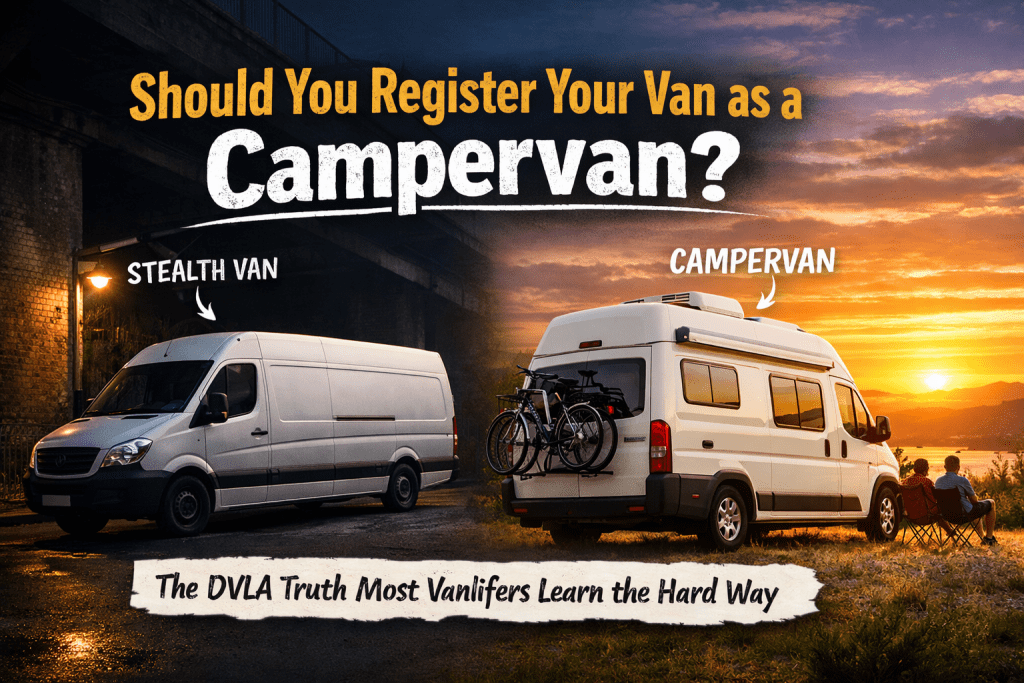
If you spend any time in vanlife Facebook groups you’ll see the same advice repeated over and over:
“You need to register your van as a campervan with the DVLA.”
The reality is very different.
Thousands of UK vanlifers are driving around in fully converted vans that still say “panel van” on the V5 — and they’re completely legal.
So should you change it to “motor caravan”… or is it a waste of time?
Let’s break down what actually happens when you try.
In a Nutshell
• You do NOT have to register a converted van as a motor caravan
• Most DIY conversions are rejected by DVLA anyway
• Insurance companies will still insure conversions without the V5 change
• Registering it can sometimes reduce insurance or MOT class
• But it can also make stealth camping harder
• Many experienced vanlifers deliberately leave the V5 as a van
The Norm
When most people start a van conversion they assume there’s some official process where you “turn a van into a camper”.
You finish the build, send some photos to the DVLA, and they update the logbook.
Nice and simple.
Except it isn’t.
Over the last few years the DVLA quietly tightened their rules. The big change was this:
Your van must look like a campervan from the outside.
Not just inside.
That means things like:
Side windows
Graphics or decals
An awning rail
High-top roof
External features that clearly show it’s a motorhome
So if you’ve built a tidy stealth camper inside a normal panel van, chances are the DVLA will simply send the photos back and say no.
This is why so many people with fully functional camper builds still have “panel van” on their V5.
And honestly — most of them stop caring.
I myself have never contemplated reregistering my converted van to a campervan, it is, though DVLA are making it difficult to change the log book to a campervan, so sod um i’ll keep my panel van status and my stealth look and forgo the few so-called advantages it may give you (see below)
The Practical Reality
Here’s the bit that surprises people.
Your V5 body type doesn’t actually control whether your van can be used as a camper.
You can legally sleep in a van.
You can legally install a bed, cooker, cupboards and electrics.
The DVLA classification is mostly just a description of the vehicle.
What matters more in the real world is insurance.
And most campervan insurers are perfectly happy to insure:
“Self-build campervan conversions.”
They simply ask for photos and a description of the conversion.
Potential Advantages of Re-Registering
There are a few genuine upsides if the DVLA approves the change.
Insurance
Some specialist camper insurers prefer the vehicle to be listed as a motor caravan. It can also sometimes reduce premiums.
MOT Class
Some vans may move from Class 7 commercial testing to Class 4, which is the same as cars.
Ferries and Tolls
Some operators charge commercial vans more than motorhomes.
Speed Limits
In certain weight categories, a motor caravan can follow normal car speed limits.
That said, for most 3.5-ton vans the difference is minimal.
The Downsides
This is where it gets interesting.
Approval is harder than people think
A lot of DIY conversions simply don’t meet DVLA visual requirements.
You may send photos and still get rejected.
Stealth disappears
Once your van is officially a motor caravan it’s clearly a camper.
That can attract attention in towns, car parks and overnight spots.
Parking restrictions
Some places that allow vans ban motorhomes.
It’s rare — but it happens.
What Most UK Vanlifers Actually Do
Talk to people who’ve been living on the road a while and a pattern appears.
A lot of them:
Convert the van
Insure it as a camper conversion
Leave the V5 as “panel van”
No drama.
No paperwork battle.
Just get on with travelling.
The DVLA label doesn’t change the fact that the van works perfectly as a home on wheels.
Registering your van as a motor caravan can make sense in some cases.
But it’s far from essential — and for many DIY builders it’s simply not worth the hassle.
So why do so many people want to change the V5 in the first place?
In many cases, it simply comes down to misunderstanding. New van builders often assume there must be an official process where a van becomes a campervan once the build is finished, and online forums repeat the same advice until it starts to sound like a rule rather than a choice.
Insurance confusion adds to this, with some people believing they won’t be covered unless the logbook says motor caravan, even though many specialist insurers are happy covering self-build conversions.
There is also a subtle element of status involved.
Having the V5 updated can feel like the build has been officially approved, as if the van has graduated from work vehicle to proper camper.
Another factor is resale value, as some sellers believe a motor caravan classification will make the van easier to sell or increase its value.
In reality, experienced buyers tend to care far more about the quality of the conversion itself — the electrics, insulation, ventilation and overall workmanship — than the wording on the logbook.
A well-built stealth conversion will usually sell on its merits regardless of what the V5 says.
The key thing to remember is this:
A campervan is defined by how you use it, not just what the logbook says.
Build the van that works for your life on the road.
The paperwork can come second.
If you’ve converted a van in the UK we’d love to hear what happened when you tried to deal with the DVLA.
Approved?
Rejected?
Or did you just leave it as a van and get on with travelling?
Drop your experience below — it might save someone else a lot of hassle.
A star rating up or down gives me direction!