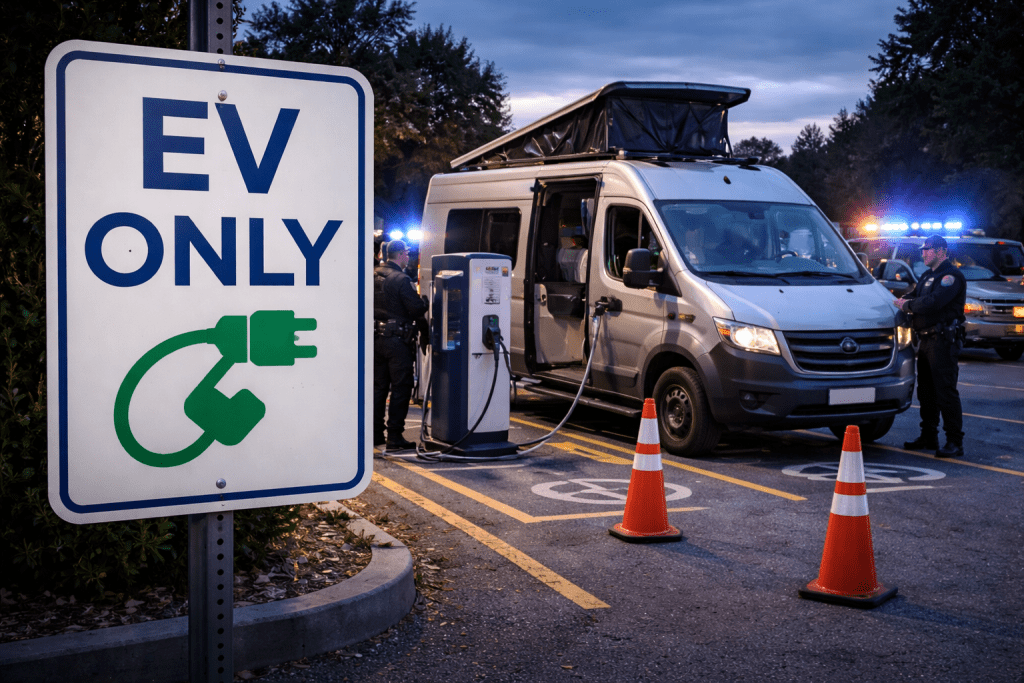
MY TAKE: DO OPERATORS ACTUALLY CARE?
Let’s be honest for a minute.
If you can physically plug in, pull power, and pay for it… what’s actually stopping you?
Not much.
And that’s where the reality starts to show.
On paper, EV charge points are designed for electric vehicles only. There’s communication, protocols, safety systems — all the proper stuff. It’s meant to be controlled, monitored, and used exactly as intended.
But out here in the real world?
If a van rolls up with an adaptor lead, draws power, and pays for it — most of the time, nothing happens.
So the question becomes:
Do operators really care?
Truth is, probably not as much as people think.
They care about:
- The charger working
- No damage being caused
- No complaints
- Money coming in
If all of those boxes are ticked, you’re not exactly top of their priority list.
That doesn’t mean it’s “allowed.”
It just means it’s not being actively chased.
There’s a difference.
It’s a bit like parking rules in some places — enforced when it matters, ignored when it doesn’t. As long as you’re not causing a problem, you can sit under the radar.
But here’s the flip side people don’t talk about:
The second it becomes a problem —
Overloading, damage, abuse, too many vans doing it —
That’s when the clampdown comes.
And when that happens, it won’t be a gentle nudge. It’ll be:
- Software locks
- Stricter detection
- Flat-out blocking anything that doesn’t behave like a proper EV
So yeah — right now, it feels like no one’s that fussed.
But that’s not permission.
That’s just a gap in the system… and those gaps don’t stay open forever.
End of the day, it comes down to this:
Just because you can plug in and get away with it today
doesn’t mean the system was ever built for you to do it tomorrow. Lets see……
This is general information based on UK rules, operator terms, and real-world use. It’s not permission or advice — you’re responsible for how you choose to use charging points.
Your comments below